Heel pain that greets you on the first step out of bed. A thickened, aching Achilles that warms up during a run and punishes you the next morning. Both are among the most common overuse injuries there are, and both usually settle with time, sensible loading and patience.
This article is not about those cases. It is about the stubborn minority — the ones still hurting after six months, twelve months, sometimes years of orthotics, stretching, rest, anti-inflammatories and a physiotherapy programme that helped a little and then plateaued.
If that is you, the useful question is not “what else can I try?” but “why hasn’t any of this worked?” The answer usually lies in a misunderstanding of what is actually wrong with the tendon.
It Is Tendinopathy, Not Tendinitis
The “-itis” suffix means inflammation, and for decades that is what these conditions were assumed to be. When researchers began examining tissue from chronically painful tendons, they largely did not find inflammatory cells. What they found was degeneration: disorganised collagen, abnormal blood vessel growth, and a matrix that had failed to remodel properly under load.
Hence the shift in terminology to tendinopathy. Plantar fasciitis is arguably misnamed for the same reason — the chronic form looks more like fasciosis, a degenerative change in the plantar fascia, than an inflammatory condition.
This is not academic hair-splitting. It explains a great deal about why your treatment has disappointed you:
- Anti-inflammatories underperform because there is limited inflammation to suppress. They may dull pain temporarily without touching the underlying tissue change.
- Rest alone rarely fixes it. Tendons remodel in response to load. Complete rest reduces pain while you are resting and leaves the tendon no better — sometimes weaker — when you return to activity.
- Corticosteroid injections can give real short-term relief but the evidence for longer-term benefit in these conditions is poor, and repeated injections around the Achilles are associated with tendon rupture. Most clinicians now avoid injecting the Achilles for this reason.
A degenerative tissue problem needs a treatment that changes the tissue.
What Should Come First
Before considering anything else, it is worth being honest about whether you have actually completed a proper loading programme. Many people believe they have failed conservative treatment when they have really only had a handful of sessions and a sheet of stretches.
For Achilles tendinopathy
Progressive loading is the best-supported first-line treatment, and it is demanding. Eccentric protocols — and more recently heavy slow resistance training — call for daily or near-daily work over roughly twelve weeks, continuing through a tolerable level of discomfort. Done properly, a substantial proportion of people improve. Done for three weeks and abandoned because it hurt, it proves nothing.
It also matters where the pain sits. Mid-portion Achilles tendinopathy (a few centimetres above the heel bone) and insertional tendinopathy (right at the heel bone) respond differently, and the insertional variety often does poorly with the classic full-range eccentric protocol. If your programme was not adjusted for which type you have, that alone may explain the plateau.
For plantar heel pain
Most cases resolve within a year with load management, calf and plantar fascia stretching, supportive footwear and progressive strengthening. Night splints have mixed evidence but help some people. Where relevant, reducing body weight measurably improves outcomes.
The honest figure is that the large majority get better with time and conservative care. The relevant group here is the remainder who do not — and they are numerous enough that heel pain is one of the most common reasons for referral to a foot specialist.
Where Focused Shockwave Therapy Fits
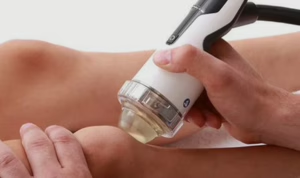
Focused extracorporeal shockwave therapy delivers targeted electromagnetic energy into the affected tissue. Rather than suppressing symptoms, it aims to provoke a repair response — stimulating blood vessel formation, growth factor release and remodelling of degenerated tissue.
The evidence here is stronger than in some other applications. Shockwave therapy for chronic plantar heel pain that has resisted conservative treatment is among the better-supported uses of the technology, appearing in randomised trials, meta-analyses and clinical practice guidelines. For Achilles tendinopathy the evidence base is more modest, and results are generally better when shockwave is combined with a loading programme rather than used instead of one.
Some practical realities worth knowing:
- It is a course, not a single treatment — typically three to five sessions spaced about a week apart
- Sessions take roughly 15 to 20 minutes, with no anaesthetic and no recovery period
- Treatment is uncomfortable while it is happening; most people describe it as tolerable
- Improvement develops over the following weeks and months, not immediately
- It does not replace your rehabilitation. Shockwave may make the tendon more receptive to loading; the loading still has to happen
- Longer-standing, more severe cases respond less consistently
Focused Versus Radial — Worth Asking About
These are different technologies often marketed under the same name. Focused shockwaves concentrate energy at a specific tissue depth; radial pressure waves disperse energy near the surface. For a deep structure like the Achilles insertion, that distinction matters. We use the Storz Medical DUOLITH SD1, a focused electromagnetic device. Ask any clinic which they operate before booking.
For Veterans, RCMP and CAF Members
Chronic tendinopathy is common among those with a service background — years of load carriage, jump training, running on hard surfaces and time on your feet in boots.
Veterans Affairs Canada authorises focused shockwave therapy for chronic tendinopathies where symptoms have persisted more than six months and conservative treatment has not resolved them. Coverage runs to three sessions per tendinopathy and requires prior authorisation. The RCMP Veterans’ Health Care Program generally aligns with VAC criteria, and active CAF members may have access through Canadian Forces Health Services.
We prepare and submit the paperwork on your behalf. Full details are on our VAC coverage page.
When It Might Not Be Tendinopathy at All
Persistent heel or Achilles pain that has not behaved as expected deserves a second look rather than another round of the same treatment. Speak to your physician if any of the following apply:
- A sudden pop or snap, sharp pain, or difficulty pushing off — possible tendon rupture, which needs urgent assessment
- Numbness, tingling or burning in the foot, which may point to nerve entrapment rather than fascia or tendon
- Pain that is worse at rest or at night, rather than with activity
- Bilateral heel pain in a younger adult, particularly alongside back stiffness or other joint symptoms, which can indicate an inflammatory arthritis
- Fever, swelling, redness, or a history of cancer or recent significant illness
Imaging is not always necessary, but where the diagnosis is uncertain or the response has been atypical, ultrasound or MRI can clarify things considerably.
Getting a Straight Answer
If tendon pain has outlasted everything you have tried, a proper assessment should tell you three things: whether the diagnosis is right, whether your rehabilitation was actually adequate, and whether focused shockwave therapy is likely to help in your particular case.
FocusWave Clinic offers complimentary assessments at our Ottawa and Kitchener-Waterloo clinics. We will tell you honestly if you are a poor candidate, and what we think you should do instead.
Call 888-558-9283 or book your complimentary assessment online.
Read more about shockwave therapy for chronic pain, the science behind the treatment, and the clinical evidence.
Important Limitations and Disclaimer
This article is for educational purposes only and does not constitute medical advice, diagnosis or a treatment recommendation. Persistent tendon pain should be assessed by a qualified healthcare professional, as several conditions can present similarly. Focused shockwave therapy is not appropriate for everyone; contraindications include certain circulatory and neurological conditions, active infection or malignancy in the treatment area, and some implanted devices. Individual results vary. VAC, RCMP and CAF coverage criteria are set by those programmes, are subject to change, and eligibility is determined by them rather than by FocusWave Clinic.